- Aromatic aster (Symphyotrichum oblongifolium)
- Big-leaf aster, Large-leaved aster (Eurybia macrophylla)
- Christmas fern (Polystichum acrostichoides)
- Common blue violet, Confederate violet (Viola sororia)
- Common wild ginger (Asarum canadense)
- Cross-vine, Crossvine (Bignonia capreolata)
- Downy phlox (Phlox pilosa)
- Dwarf crested iris (Iris cristata)
- Fragrant sumac (Rhus aromatica)
- Golden ragwort, Heartleaf ragwort (Packera aurea)
- Goldie's wood fern (Dryopteris goldieana)
- Green and gold (Chrysogonum virginianum)
- Ladies' tabacco, Plantain-leaved everlasting (Antennaria plantaginifolia)
- Marginal wood fern (Dryopteris marginalis)
- Narrow-leaved blue-eyed-grass, Narrow-leaved blue-eyed grass (Sisyrinchium angustifolium)
- Partidge-berry (Mitchella repens)
- Robin's plantain (Erigeron pulchellus var. pulchellus)
- Trumpet honeysuckle, Coral honeysuckle (Lonicera sempervirens)
- Virginia bluebell, Virginia cowslip (Mertensia virginica)
- Virginia-creeper, Virginia creeper (Parthenocissus quinquefolia)
- Wild blue phlox, Woodland phlox (Phlox divaricata)
- Wild stonecrop, Woodland stonecrop (Sedum ternatum)
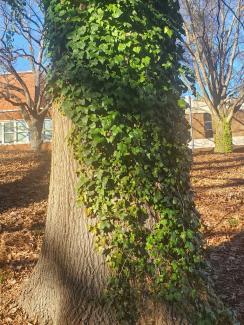
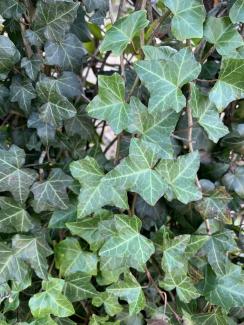
Notes: One of the most popular ground covers in North America, this non-native climbing vine was introduced by early European colonists. Its vigorous growth creates an “ivy desert” as it chokes out other plants on the ground, and it poses a threat to both buildings and trees as it grows up vertical surfaces. The plant is reported as invasive throughout the Mid-Atlantic Region, including Alexandria and Arlington, Virginia.
Identification: Hairy roots; Thick, leathery leaves
Method of removal: Hand pull where practical, otherwise foliar spray when native plants are dormant.
Attention! DO NOT COMPOST; Resprouts; Reroots; Can cause rash
Additional Note: MGNV's Suggested replacement: Rhus aromatica is the "Gro-Low" cultivar (Rhus aromatica ‘Gro-Low’ (Fragrant Sumac))